Concrete Jungle vs. Concrete Park: The Great Debate Over Where Skateboarding Actually Gets Made
There are two kinds of skaters in every crew. You know who they are.
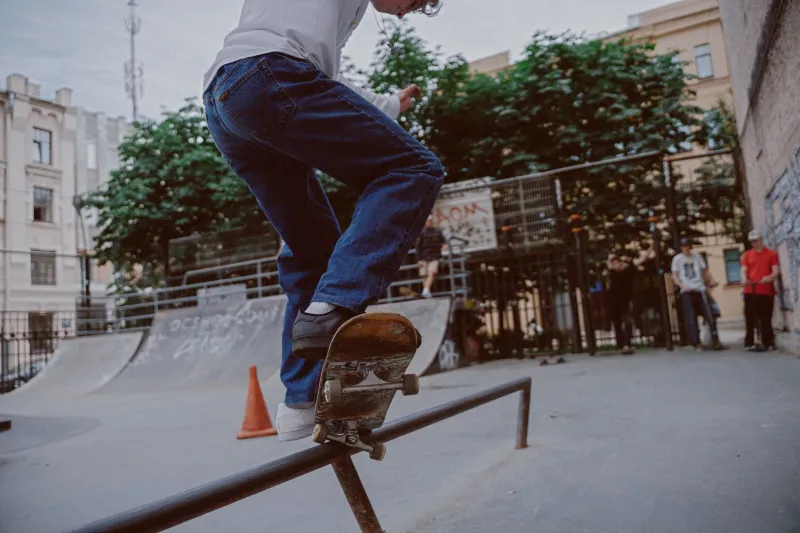
One of them grew up hunting spots — cracked banks behind strip malls, forgotten loading docks, that one perfect ledge outside a closed-down Sears that the crew kept secret for three years. The other one practically lived at the local park, knows every transition by heart, and can tell you exactly which slab of concrete in the flow bowl has a crack you need to avoid.
Both of them rip. But ask them how they learned to skate, and you'll get two completely different answers — and two completely different philosophies about what skateboarding is actually for.
The DIY Education
There's a certain kind of knowledge you can only get from skating spots that were never meant to be skated.
Street legends from the 1990s and early 2000s — the generation that built the visual language of modern skateboarding — didn't have the luxury of perfectly designed transitions and smooth, freshly poured concrete. They had whatever the city left behind. Hubba Hideout. EMB. The Brooklyn Banks. Spots that were ugly, inconsistent, and occasionally dangerous, and that produced some of the most creative skating the world has ever seen.
"When you're skating a spot that wasn't built for you, you have to figure out how to make it work," said Marcus Webb, a longtime street skater from South Los Angeles who helped build a well-known DIY spot in his neighborhood that's since become a local institution. "You're not just learning tricks. You're learning how to see."
That visual creativity — the ability to look at a parking garage, a drainage ditch, or a crumbling bank and immediately see its potential — is something that DIY environments develop in a way that designed parks simply can't replicate. It's an improvisational intelligence, a kind of spatial problem-solving that bleeds into every other part of a skater's game.
DIY spots also carry a different kind of social texture. They're usually discovered rather than announced, shared through word of mouth and earned trust. The culture around them tends to be tighter, more self-policing, and more deeply invested in the spot's preservation. You don't disrespect a place that took years to find.
What the Park Actually Teaches
Here's the thing the DIY purists sometimes miss: modern concrete parks are genuinely incredible training environments, and the generation that grew up in them is technically as good as any that came before.
The consistency of a well-designed park allows for a kind of focused progression that chaotic street skating rarely offers. You can run the same line fifty times in a session without worrying about getting kicked out, waxing a ledge, or negotiating with a security guard. The learning curve compresses. The feedback loop tightens.
"I learned more about body mechanics at the skate park than I ever would have on the street," admitted Jenna Calloway, a 22-year-old amateur from Phoenix who's been competing on the national circuit since she was fifteen. "The park gave me a foundation. Now I can take that foundation anywhere."
Park skating also democratizes access in a real way. Not every kid grows up in a neighborhood with good street spots. Not every kid has older skaters to show them around. A public skate park — especially a well-maintained one — gives anyone with a board a place to start, regardless of their zip code or their crew.
That matters. A lot.
The Risk-Reward Math
Let's be honest about something: street skating carries real consequences that park skating largely doesn't.
Getting kicked out is the minor version. Skating a sketchy spot without knowing its quirks — a hidden seam, a surface that goes wet fast, a drop that's deeper than it looks — can end sessions and sometimes careers. The risk is part of the culture, no question. But it's worth being clear-eyed about what you're trading for the authenticity of a raw street spot.
DIY builders, who invest enormous amounts of their own time and money into creating illegal or semi-legal spots, carry a particular kind of burden. The spots can be demolished with zero notice. The community that built them has no legal recourse. Years of work can disappear overnight.
"We've had spots get bulldozed three times," Webb said. "You just rebuild. But it takes something out of you."
Parks, for all their sanitized edges, offer something the street never can: permanence. Or at least, the closest thing to it.
Gentrification and the Disappearing Landscape
This is where the conversation gets complicated — and urgent.
Across American cities, the spots that shaped generations of skaters are disappearing. Not just through natural decay, but through development. Neighborhoods are changing. Old commercial zones that once harbored perfect ledges and forgotten plazas are being converted into luxury condos and boutique retail. The texture of the urban environment that made street skating possible is being sanded smooth.
At the same time, cities are building more public skate parks than ever before — partly as a way to manage the skateboarding population, partly because skating's cultural legitimacy (and its Olympic status) has made it politically palatable in ways it wasn't twenty years ago.
The irony is sharp. Skateboarding gets more infrastructure just as it loses the raw material that made it interesting.
"The parks are great," said one veteran skate photographer from San Francisco who's documented the Bay Area scene for two decades. "But they're not replacing what we're losing. They're just filling a different hole."
So Which One Actually Made You Better?
Honestly? Probably both. Probably in different ways.
The skaters who come up purely on parks sometimes struggle when they hit real street terrain — the unpredictability throws them off, the imperfection feels like an obstacle rather than an invitation. The skaters who only know the street can miss out on the technical refinement that consistent, controlled practice makes possible.
The best riders, across generations, tend to be the ones who moved between both worlds. Who learned to read a spot AND learned to run a line clean. Who carried the creativity of the street into the park and the discipline of the park back onto the street.
That synthesis — chaotic and controlled, raw and refined — might be the closest thing there is to a complete skate education.
Where did you learn? Drop it in the comments. The debate is very much alive.