Shred School: How Skateboarding and Surfing Are Secretly Training You for Life
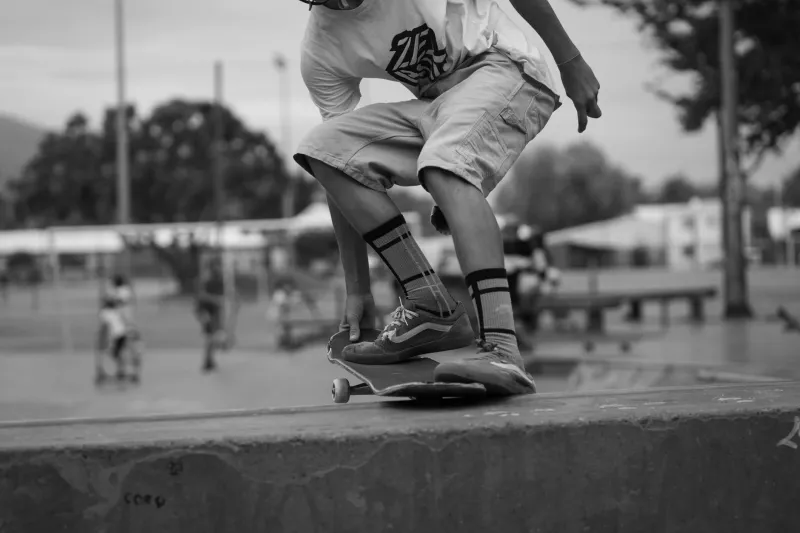
You've eaten pavement more times than you can count. You've paddled into waves that had no business being paddled into. You've stood at the top of a sketchy drop, heart hammering, and decided to go anyway. What you probably haven't done is sit back and think about what all of that is actually doing to your brain — and your life.
Turns out, every slam, every wipeout, every moment you talked yourself off a ledge and then right back onto it is building something. And it's not just calluses.
The Mental Wiring Nobody Talks About
Neuroscientists have been quietly fascinated by extreme sports athletes for years, and the findings are kind of wild. When you're learning a new trick or reading a wave, your brain is doing a full-on systems update — processing spatial data, recalibrating risk assessments, and building new neural pathways at a pace that most traditional learning environments just can't match.
Dr. Kylie Moran, a cognitive neuroscience researcher based out of UC San Diego who also grew up surfing, puts it plainly: "The kind of dynamic, real-time problem-solving that happens in surfing or skateboarding activates the prefrontal cortex and the cerebellum simultaneously. You're essentially running your decision-making hardware and your motor-learning hardware at the same time. That kind of dual activation has serious carryover into how people handle complexity in other areas of their lives."
Translation: every time you figure out how to adjust your weight mid-trick or read the way a wave is about to section, you're training your brain to think faster, adapt quicker, and stay calm when things go sideways. That's not a small thing.
From Skateparks to Startups
Ask Marcus Delgado, a 29-year-old product designer in Austin, Texas, and he'll tell you skateboarding basically taught him how to run a business.
"I started skating when I was nine. By the time I was in high school, I was filming my own edits, designing graphics for my crew's homemade decks, and figuring out how to get free product from local shops by building relationships," he says. "I didn't know it at the time, but I was learning project management, visual design, and sales. When I got into the startup world, I already had all of that in my body."
Marcus isn't alone. A surprising number of founders, creatives, and high-performers in competitive industries trace their edge back to the skatepark. The reason makes sense when you break it down: skateboarding, especially street skating, is fundamentally about creative problem-solving within constraints. Every spot is a puzzle. Every trick attempt is a hypothesis. Every slam is data.
That iterative mindset — try, fail, adjust, try again — is basically the entire philosophy behind modern product development and entrepreneurship. The skate world just calls it "putting in the hours."
Spatial Intelligence and the Surfer's Edge
Surfing builds a different but equally transferable skill set. Reading a break requires synthesizing wind direction, swell period, tide level, and crowd dynamics into a split-second decision. Do it enough times and you develop what psychologists call "environmental spatial intelligence" — the ability to rapidly interpret complex, shifting systems.
Jamila Okafor, a 34-year-old urban planner in Los Angeles who grew up surfing in Malibu, says she noticed the connection the first time she had to analyze traffic flow patterns for a city infrastructure project.
"I kept thinking about how I read lineups," she says. "You're watching how energy moves through a space, where the bottlenecks are, how small changes upstream affect everything downstream. It's literally the same mental model. My boss thought I was some kind of prodigy. I was like, nah, I've just been doing this since I was twelve."
The ability to read systems — to zoom out, see patterns, and anticipate change — is one of the most valued skills in fields from engineering to finance to medicine. And surfers are building it every single time they paddle out.
Resilience Is the Real Product
Here's the thing that doesn't show up on any resume but matters more than almost anything else: action sports athletes are exceptionally good at failing.
Not in a reckless way. In a calibrated, keep-going way. When you spend years chasing a trick that you can't land, or a wave that keeps breaking wrong, you develop a relationship with failure that most people never get. You stop seeing it as a verdict and start seeing it as a process.
That reframe is huge. Research on resilience consistently shows that people who can maintain motivation through repeated setbacks outperform their peers across virtually every measurable outcome — academic achievement, career advancement, relationship stability. Psychologists call it "grit." Action sports athletes just call it showing up to the session.
"I bombed my first semester of college," admits Tyler Nguyen, a 26-year-old mechanical engineering student in San Jose who's been skating since middle school. "But I never actually thought about quitting. In skating, you just don't quit. You go back the next day. I applied that exact same logic to school, started grinding differently, and now I'm doing research on aerospace components. Skating taught me that the gap between where you are and where you want to be is just reps."
The Relationship Angle Nobody Expected
This one surprises people, but hear it out. Action sports culture — at its best — is built on radical honesty. Your crew will tell you when your form is off, when your line is sketchy, when you're not ready for that drop. There's no room for ego-protecting lies when someone's physical safety is on the line.
That culture of direct, caring feedback turns out to be exactly what healthy relationships need. Multiple athletes interviewed for this piece mentioned that the communication skills they developed in their crews — how to give hard feedback without being cruel, how to hype someone up without being fake, how to read when a friend needs a push versus a hand — carried directly into their personal lives.
"My skating crew basically taught me emotional intelligence," says Priya Castillo, a 31-year-old nurse in Denver who grew up skating. "We looked out for each other. We were honest with each other. I use those exact same skills every single day at work and at home."
The Takeaway
Nobody picks up a skateboard or paddles out for the first time thinking they're investing in their career or their relationships or their mental health. They do it because it's fun, because it's freedom, because something about it just hits different.
But the gains stack up. Quietly, persistently, in the background of every session, every slam, every time you dust yourself off and go again. The board is teaching you things that classrooms can't. The wave is building something in you that no corporate training program could replicate.
So next time someone asks why you still skate at 25, or why you still drive two hours to surf a mediocre break, you've got a better answer than "it's just fun."
Although honestly? That's reason enough too.