What Your Board Taught You That School Never Could
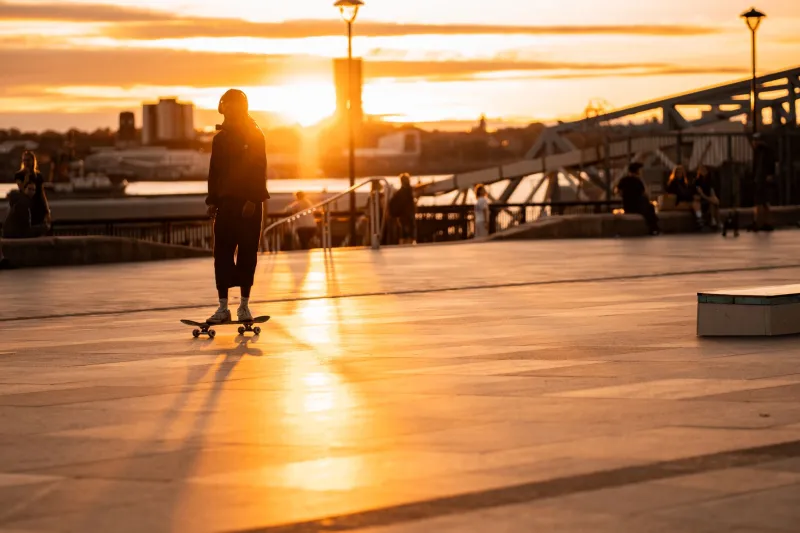
There's a moment every skater knows. You've been trying the same trick for two hours. Your shins are wrecked, your ego's bruised, and some part of your brain is screaming at you to quit. Then something shifts — not just in your feet or your timing, but in how you're thinking. You stop fighting the board and start listening to it. And suddenly it clicks.
What just happened there isn't just skateboarding. That's a skill. A real, transferable, life-altering skill. And the wild thing is, most of us have been building a whole toolkit of them without ever realizing it.
Your Body Knows Things Your Brain Hasn't Caught Up To
Ask any surfer what spatial awareness means and they'll probably shrug. Ask them to describe reading a wave — the angle, the speed, where it's going to break, how their board will respond — and they'll talk for twenty minutes. That's spatial awareness. Elite-level spatial awareness, actually.
Mike Tavares, a surfer out of Santa Cruz who now works as an architect, says the connection between the two disciplines hit him like a set wave he didn't see coming. "I was in my first design review, trying to visualize how a space would feel from the inside out, and I just... could. I'd been doing that on the water for fifteen years. Reading how a space moves, where the energy flows, what's going to happen next. Architecture and surfing are basically the same problem."
He's not exaggerating. The neurological demands of board sports — processing movement in three dimensions, anticipating outcomes, making micro-adjustments in real time — build a kind of spatial intelligence that classrooms rarely develop. It's embodied knowledge, the kind that lives in your muscles and reflexes as much as your conscious mind.
Risk Assessment Isn't Just for Big Waves
Here's one people don't talk about enough: action sports athletes are really good at evaluating risk. Not recklessly ignoring it, not paralyzed by it — actually calculating it with a kind of calm precision that most people never develop.
Jordan Reyes has been skating street in Los Angeles since he was nine. He now runs a small creative agency, and he says his approach to business decisions maps almost perfectly onto how he sizes up a spot. "When I'm looking at a new rail or a gap, I'm not just asking 'can I do this?' I'm asking what happens if I go too fast, what happens if I go too slow, what's the worst-case landing, what's the bail-out plan. I run that same checklist on every client pitch. Every contract. Every hire."
That's not recklessness — that's sophisticated risk modeling. The difference between a skater who progresses and one who stays stuck is often the ability to accurately assess what's actually dangerous versus what just looks scary. That skill translates. Hard.
Creativity Isn't Optional — It's Survival
In most sports, the rules are fixed. The court is a certain size, the ball behaves a certain way, and success means executing within a defined framework. Skateboarding and surfing don't work like that. Every spot is different. Every wave is different. The environment is always changing, and creativity isn't a bonus — it's how you stay in the game.
Dani Cho grew up skating in Chicago and has been playing in indie bands since her teens. She says the creative process feels identical. "When I'm writing a guitar part, I'm looking for the same thing I'm looking for at a new spot — the unexpected line. The angle nobody else tried. In skating, you're constantly asking 'what else could this be?' That's the exact question that makes a song interesting."
This is what separates board sport culture from a lot of other athletic traditions. There's no coach handing you the playbook. You're inventing your approach in real time, every session. That kind of creative autonomy shapes how you think about everything — art, music, work, relationships.
Balance Is a Metaphor (and Also Literally Very Useful)
Okay, the balance thing sounds obvious, but stay with it for a second. The balance required in surfing and skating isn't just physical equilibrium — it's the constant negotiation between control and letting go. You can't muscle your way through a bottom turn. You can't force a manual. At some point, you have to surrender to the motion and trust that your body will handle it.
Therapists have a word for this: distress tolerance. The ability to stay present and functional when you're in an uncomfortable, unstable situation. Surfers and skaters develop this on a deep level because their sports literally require it. You fall, you get up. The wave closes out, you paddle back. There's no catastrophizing — there's just the next attempt.
Marcus Webb, a BMX rider from Portland who now coaches youth mental health programs, has built his entire curriculum around this idea. "The kids I work with, a lot of them have never had a safe space to fail. When I get them on bikes, something changes. They start to understand that discomfort isn't the end of the story. That's the most important thing I can teach them, and the bike teaches it better than I ever could."
The Thing Nobody Tells You at the Start
When you pick up a board for the first time, nobody hands you a brochure that says this will change how you think, create, work, and connect with people. You're just trying not to eat concrete. But somewhere in the grinding repetition of learning to ride — in the slams and the breakthroughs and the sessions that go until the sun disappears — something gets rewired.
You learn to read environments. You learn to calculate risk without freezing. You learn to find creative solutions when the obvious one isn't working. You learn that discomfort is temporary and progress is possible and that sometimes the best thing you can do is stop thinking and just go.
Those aren't just athletic skills. They're life skills. The board just happens to be the place where you found them.
So next time someone asks why you still skate, or why you're always chasing waves, or why you'd rather spend a Saturday at the park than literally anywhere else — you can tell them the truth. You're not just having fun. You're getting an education.